The Prime Minister
10 Downing Street
London
SW1A 2AA
100 Any Road
Typical Town
County
England
Date: 24th October 2006
Dear Prime Minister
Parental Choice of School
I would first like to say it is obvious that an enormous amount of effort and money has been spent on education over the years that New Labour has been in power. This is good!
I believe that education is the fundamental basis on which our democracy rests. Without the goodwill of the people democracy cannot exist. To achieve this goodwill we need an educated populace and a high degree of moral character and education among those that teach us and govern us. Inevitably this is an expensive and difficult undertaking. However, the cross party support for Parental Choice of School and the very serious problems that this concession has given rise to is, among many people, becoming a very good reason to doubt the ability of this and any other government to solve.
The example given below, and there must be many more, throughout the country, is the reality of the essential problem that faces parents in their choice of school for their children. It involves where they live and their local school.
Freshford Church of England Primary School is situated in Bath and North-East Somerset (BANES) the school is located in the centre of Freshford. The village consists of several hamlets within walking distance of the school. Children go to the school until they are eleven and then they go on to secondary education locally. Apparently their parents have a choice, well they don’t! Because Freshford is partly within BANES and partly within Wiltshire.
Those children, who have matured together, whose parents, villagers, neighbours, now find that they are to be separated from their classmates by reason of their geographical location. Most of the children will go to Ralph Allen in BANES and the others will go to St Lawrence in Bradford On Avon. Whilst a few, whose parents can afford it, will go on to be privately educated.
God did not put those boundaries where they are. Man could decide to relocate the boundaries in order to place the village wholly in BANES or wholly in Wiltshire. Another option, which would solve this and similar unacceptably, antisocial interferences in the natural social development of our children and grandchildren would be to give parents the right of choice to go to their nearest school; especially where the family lives near a county or other boundary. In this case, parents in Freshford whether they reside in BANES or Wiltshire should have the right to choose whether to send their children either to Ralph Allen or St Lawrence
Yours sincerely
A. Citizen
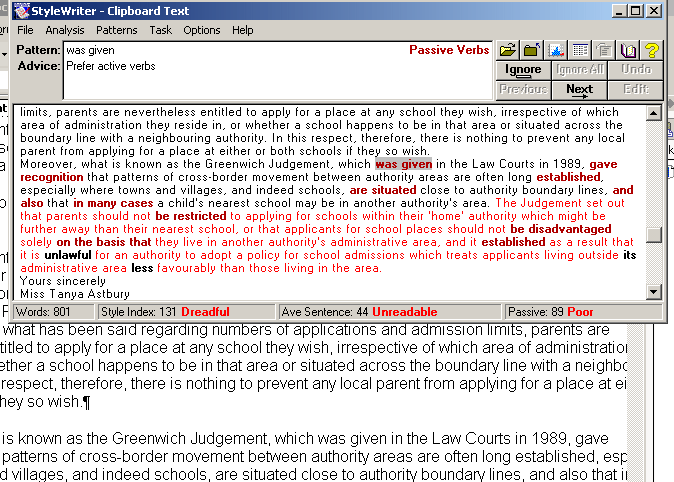
A reply to the above letter is published below. It was received quite a while ago but owing to a problem with scanner software publication had to be deferred. On reflection, one of the problems that has also delayed publication, has been the poor standard of English in this letter. See below for a StyleWriter screenshot of the analysis of the letter.
As a consequence of the complexity of this letter's structure, I have numbered each paragraph, before replying.
department for education and skills
creating opportunity, releasing potential, achieving excellence
Castle View House P.O. Box 12, Runcorn Cheshire, WA7 2GJ
Our ref: 2006/0326805
20 November 2006
Dear Sir
1. Thank you for your letter of 24 October, addressed to the Prime Minister, concerning the education system, the school applications and admissions process, and the secondary transfer system within your own particular local area. As you will appreciate, the Prime Minister receives a vast amount of correspondence each day and cannot reply to every letter personally. Your letter has therefore been passed to this Department as we have responsibility for educational issues such as school admissions.
2. I should explain firstly that, whilst the government is responsible for the wider statutory framework, including the School Admissions Code of Practice, school admission arrangements are essentially a local issue and are dealt with at that level by the relevant admission authority for the school in question: for community or voluntary controlled schools such as Ralph Allen School or St Laurence School this is the local authority for the area in which the school is situated, whereas for foundation or voluntary aided schools it would be the governing body of the school itself.
3. The law provides for parents to express a preference for the school they want their child to attend (rather than having a specific choice of school). Ministers do want as many parents as possible to be able to gain a place for their child at their preferred school and they try to ensure that school admission arrangements support parental preference as much as possible. However, there can never be any guarantee that parents will be able to gain a place at their preferred school in every case. Schools have only a finite number of places to offer and, where a school has more applicants than there are places available, it is inevitable that the admission authority will be unable to meet everyone's preference.
4. When schools are oversubscribed in this way the admission authority must allocate the places according to the published admissions criteria, until the admission limit is reached, and it is the responsibility of each individual admission authority to determine and publish its own criteria for prioritising applications, including any decision about specifically prioritising local children for admission (for example, by way of a catchment area policy, or by distance from home to school). As regards the schools in your own area, (i.e. Ralph Allen School or St Laurence School), the admission arrangements for both schools do give a significant measure of priority to local children. The arrangements for Ralph Allen School specify Freshford as one of several parishes within the 'Priority C category of the school's admission arrangements, and the arrangements for St Laurence School also include a designated area. Although it is not clear whether or not Freshford comes within this area,
5.distance from home to school is utilised to determine those applications that are either out-of-catchment or non-siblings.
6.On a further point from your letter, you say that parents in Freshford should be able to choose whether to send their children to either of the local schools, and that the situation is complicated by Freshford being situated geographically on the boundary of Bath & North East Somerset and Wiltshire. In itself, however, this doesn't lead to any reason why Freshford parents cannot apply to whichever school is situated within the 'other' area. Whilst bearing in mind what has been said regarding numbers of applications and admission limits, parents are nevertheless entitled to apply for a place at any school they wish, irrespective of which area of administration they reside in, or whether a school happens to be in that area or situated across the boundary line with a neighbouring authority. In this respect, therefore, there is nothing to prevent any local parent from applying for a place at either or both schools if they so wish.
7.Moreover, what is known as the Greenwich Judgement, which was given in the Law Courts in 1989, gave recognition that patterns of cross-border movement between authority areas are often long established, especially where towns and villages, and indeed schools, are situated close to authority boundary lines, and also that in many cases a child's nearest school may be in another authority's area. The Judgement set out that parents should not be restricted to applying for schools within their 'home' authority which might be further away than their nearest school, or that applicants for school places should not be disadvantaged solely on the basis that they live in another authority's administrative area, and it established as a result that it is unlawful for an authority to adopt a policy for school admissions which treats applicants living outside its administrative area less favourably than those living in the area.
Yours sincerely
Miss Tanya Astbury
Public Communications Unit
A reply to this letter is published below. Because of the original letter's complexity I had to include it in my reply
Castle View House
P.O. Box 12
Runcorn
Cheshire
WA7 2GJ
Your ref: 2006/0326805
Dear Miss Tanya Astbury
Thank you for your letter. I have split your letter to me into numbered paragraphs and have written my response to your observations in blue. Paragraph 3 has been split into 3a and 3b. This letter will be published on: www.lettertothepm.co.uk a few days after posting it to you
1. Thank you for your letter of 24 October, addressed to the Prime Minister, concerning the education system, the school applications and admissions process, and the secondary transfer system within your own particular local area. As you will appreciate, the Prime Minister receives a vast amount of correspondence each day and cannot reply to every letter personally. Your letter has therefore been passed to this Department as we have responsibility for educational issues such as school admissions.
2. I should explain firstly that, whilst the government is responsible for the wider statutory framework, including the School Admissions Code of Practice, school admission arrangements are essentially a local issue and are dealt with at that level by the relevant admission authority for the school in question: for community or voluntary controlled schools such as Ralph Allen School or St Laurence School this is the local authority for the area in which the school is situated, whereas for foundation or voluntary aided schools it would be the governing body of the school itself.
2. This is a restatement of what I already know, i.e. That the admission of a child to a local school is subject to the local authority’s rules therefore they can implement rules for selecting children based on criteria that can effectively exclude some children that live locally. This is because the school’s admission policy uses the term “local” to mean within the LEA (which is itself tied to a county or other artificial area) Rather than local in the sense of being close to, a geographical concept.
3a. The law provides for parents to express a preference for the school they want their child to attend (rather than having a specific choice of school). Ministers do want as many parents as possible to be able to gain a place for their child at their preferred school and they try to ensure that school admission arrangements support parental preference as much as possible. However, there can never be any guarantee that parents will be able to gain a place at their preferred school in every case.
3a. Since, foundation and voluntary schools may use their own criteria and thus reject children who are not for example Christian (lower category) there is a further barrier to parents expressing their so-called “parental choice” Where as the government and in particular the Prime Minister has the view that according to a Downing Street spokesman 7th March in the Independent Online Edition::
“what the Prime Minister supports absolutely is the right of parents to make choices about their children's education which are best suited to their children's needs irrespective of who their parents are or what job they do “
(i.e. if you have the money you have freedom of choice) The general public believe that they have been promised a choice of school for their children not just a preference. This is due to failure of the government to make its promises understandable to the average citizen.
3b Schools have only a finite number of places to offer and, where a school has more applicants than there are places available, it is inevitable that the admission authority will be unable to meet everyone's preference.
3b. All local schools, correction ALL SCHOOLS because all state schools are local schools should have been built to cater for local people, as the population increases or decreases the school should be able to accommodate the extra children or if it can’t should be automatically eligible for funding for additional building...
3b Since the government has decided to no longer manage this problem and has even reduced the powers of the LEA and in some cases has made the problem worse by allowing LEA’s to close schools when pupil numbers have fallen –end of baby booms etc it then blames the teachers and parents and the local authority when things deteriorate. Schools should NOT have a finite number of places; they should have sufficient places to meet the needs of the local community. (Refers to paragraph 4 below as well)
4. When schools are oversubscribed in this way (they don’t need to be, if it has sufficient buildings and excludes non-local people) the admission authority must allocate the places according to the published admissions criteria, until the admission limit is reached, and it is the responsibility of each individual admission authority to determine and publish its own criteria for prioritising applications, including any decision about specifically prioritising local children for admission (for example, by way of a catchment area policy, or by distance from home to school). As regards the schools in your own area, (i.e. Ralph Allen School or St Laurence School), the admission arrangements for both schools do give a significant measure of priority to local children. The arrangements for Ralph Allen School specify Freshford as one of several parishes within the 'Priority C category of the school's admission arrangements, and the arrangements for St Laurence School also include a designated area. Although it is not clear whether or not Freshford comes within this area,
4. So you don’t know? Or have been unable to find out? I’ll repeat that there are children that live in Freshford that are a stones throw from their primary school who because of the county/parish boundaries are not allowed to attend one or the other of their local schools. Sure, the parents can apply to either school and will be placed higher or lower in an admissions policy category that must mean that very few will be able to go to their preferred school and they may find that because they have applied to one school rather than another they will be placed on a lower category for having applied to the other school.
5. distance from home to school is utilised to determine those applications that are either out-of-catchment or non-siblings. This factor is given low priority by schools. And in spite of the “Greenwich Judgement” as mentioned below (7) does not given parents equal opportunity where two familes live the same distance from the school but one of those families is out-of-catchment (because the family lives in another county.parish) This comment also applies to paragraph 6 below.
6. On a further point from your letter, you say that parents in Freshford should be able to choose whether to send their children to either of the local schools, and that the situation is complicated by Freshford being situated geographically on the boundary of Bath & North East Somerset and Wiltshire. In itself, however, this doesn't lead to any reason why Freshford parents cannot apply to whichever school is situated within the 'other' area. Whilst bearing in mind what has been said regarding numbers of applications and admission limits, parents are nevertheless entitled to apply for a place at any school they wish, irrespective of which area of administration they reside in, or whether a school happens to be in that area or situated across the boundary line with a neighbouring authority. In this respect, therefore, there is nothing to prevent any local parent from applying for a place at either or both schools if they so wish.
6. Even the most uneducated parent knows that this would be a waste of time and I am surprised that an officer in your position can be seriously suggesting this approach.
7. Moreover, what is known as the Greenwich Judgement, which was given in the Law Courts in 1989, gave recognition that patterns of cross-border movement between authority areas are often long established, especially where towns and villages, and indeed schools, are situated close to authority boundary lines, and also that in many cases a child's nearest school may be in another authority's area. The Judgement set out that parents should not be restricted to applying for schools within their 'home' authority which might be further away than their nearest school, or that applicants for school places should not be disadvantaged solely on the basis that they live in another authority's administrative area, and it established as a result that it is unlawful for an authority to adopt a policy for school admissions which treats applicants living outside its administrative area less favourably than those living in the area.
7. Schools are discriminating in this way and Ralph Allen school has done so as is evident in my letter to the Prime Minister. They should be stating this judgement in the documentation they send to parents. Is your department advising schools in this respect.? The only reference that I could find in School Admissions Code is:
2.38 Some schools establish a number of small catchment areas some of which are some distance from school. This practice can exclude some families and if used along with certain other criteria such as partial selection by ability or aptitude or siblings can substantially limit the number of places for families living nearer the school. If using catchment areas in this way admission authorities should (bold as printed) take into account the possible effect of their other oversubscription criteria and the admission arrangements at other schools in the area in limiting access to the school. http://www.dfes.gov.uk/sacode/docs/DfES%20Schools%20text%20final.pdf
So some schools have adopted a system of categories to determine intake that will discriminate against those parents. And this situation is apparently going to continue as the legal document uses “should” rather than “must” That is a situation where parents that live miles away from the school may have higher priority than those parents that live nearer to the school..
Do you feel that the parents in Freshford would be allowed to send their children to their local school if they objected on a point of law? Would they have to pay for legal costs, if so, then the option is not feasible?
I will restate my proposal:
Parents should have the right to select the nearest school to where they live for their children’s education; whether or not they live in another county or parish or metropolitan area or in England, Wales or Scotland.
Yours Sincerely
A. Citizen
Parents should have the right to select the nearest school to where they live for their children’s education; whether or not they live in another county or parish or metropolitan area or in England, Wales, Northern Ireland or Scotland or even Eire.
(Added later)